
ESL Grammar Lesson: Reminiscing About Younger Life and Past Habits (Used To vs. Would | B1–B2)
One of the most persistent hurdles for intermediate (B1–B2) English learners when discussing past experiences is distinguishing between repeated dynamic actions and past states. While students quickly become comfortable using “used to” for broad generalizations, they frequently stumble when integrating “would” into nostalgic storytelling. Because many native languages rely on a single past imperfective tense or contextual adverbs rather than distinct modal structures, learners often overgeneralize “would” to stative verbs, producing ungrammatical utterances such as “When I was young, I would live near the beach” or “She would have short hair.” Conversely, when learners do not understand the descriptive warmth of “would,” their personal narratives can feel repetitive and mechanically tied to the past simple or “used to.” Isolated conjugation drills fail to solve this issue because students need to experience how these forms interplay in extended, emotive discourse.
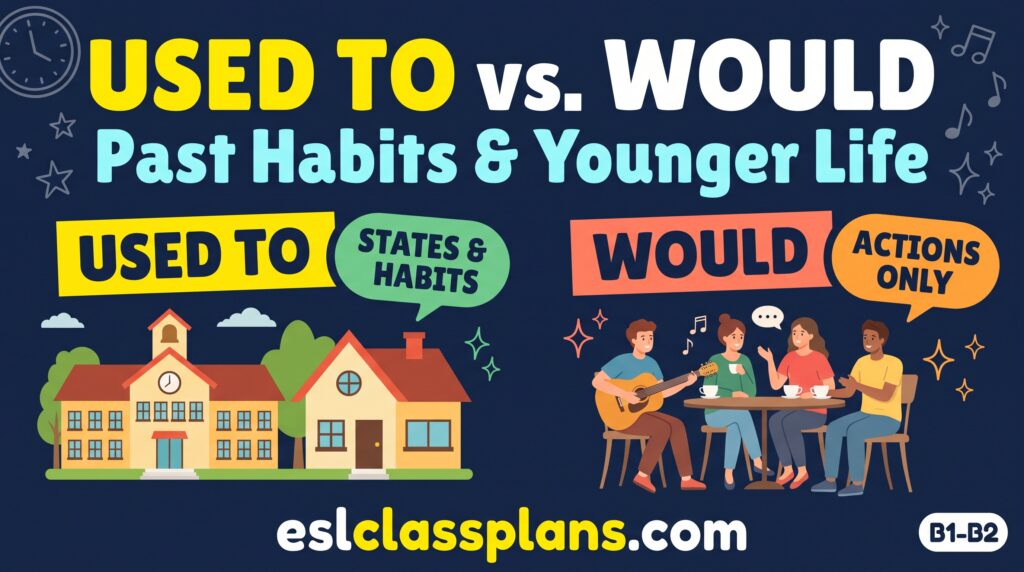
This ready-to-teach lesson plan resolves this friction through Communicative Language Teaching (CLT) and contextualized discovery. Rather than treating the topic as an abstract grammar rule, the lesson grounds target structures in the relatable theme of youth, university memories, and personal growth. Students progress from schema-activating warm-up questions through explicit stative-verb analysis, controlled discrimination tasks, a journal reading, and an immersive multi-part alumni reunion role-play. By the end of the lesson, students can fluidly alternate between setting historical states and recounting repeated routines, unlocking greater stylistic depth in both social and narrative English.
What’s Inside This Lesson Plan?
- Nostalgic Schema-Building Warm-Up: Engaging discussion prompts invite learners to reminisce about favorite teenage music bands, local hangout spots, and memorable weekend routines.
- Stative vs. Dynamic Structural Analysis: Clear grammar guidelines that explicitly contrast “used to” and “would,” highlighting why stative verbs like be, have, and know cannot take “would.”
- Dual-Possibility Sentence Completion: A targeted gap-fill activity where learners evaluate past contexts-such as studying late, apartment living, and early career expectations-to decide whether “used to,” “would,” or both forms can be used.
- “A Journal from the Past” Reading Passage: An evocative paragraph exploring early-twenties city life, hidden bookshops, and carefree routines that models how native speakers blend both forms in narrative prose.
- Three-Part College Alumni Reunion Role-Play: A communicative speaking task where student partners meet at an alumni event to discuss campus changes, eccentric professors, and former weekend hobbies like playing in local music bands.
Core Target Language Spotlight
This lesson builds communicative precision by contrasting enduring past states with habitual, repeated actions.
- Contrasting Past States with Repeated Past Actions:
"We used to live in the city center."vs."Every Friday, we would go out dancing." - Narrative Blending of Habits and Former Beliefs:
"We used to believe that we had all the time in the world."/"We would discover hidden bookshops, and our friends would meet us for late-night coffee."
Download the Ready-to-Print Classroom Handout
Equip your classroom with an adaptable, zero-prep slide deck and worksheet packet engineered for immediate delivery. Whether you are teaching face-to-face or screen-sharing through Zoom, Microsoft Teams, or Google Meet, this complete resource includes clear grammar references, guided prompts, reading contexts, and interactive role-play cue cards.
📥 Download Printable Materials
Click below to access your printable PDF classroom materials.
Teacher’s Tip for the Classroom
Introduce the “Movie Scene vs. Still Photograph” visual test to eliminate student errors with stative verbs. When students hesitate over whether “would” is acceptable, ask them: “Can you visualize this as a continuous movie scene repeating in motion (e.g., dancing, discovering bookshops, drinking coffee), or is it a still photograph describing a state of being (e.g., having an apartment, believing an idea, living somewhere)?” If it is a “still photograph” (a stative verb like be, have, know, or believe), remind them that only “used to” is permitted. Additionally, drill the reduction of “used to” into natural spoken English (/ˈjuːstə/) so students drop the rigid final /d/ sound and transition smoothly into subsequent infinitives during the alumni role-play.


