
Navigating conditional forms is a notorious stumbling block for intermediate (B1–B2) English learners because the challenge lies far deeper than grammatical formulas. While students can readily memorize the mechanical equations of conditional clauses, they often struggle with the underlying concept of psychological distance. In many native languages, hypothetical meaning is conveyed through distinct subjunctive inflections or mood particles rather than a tense backshift. Consequently, learners frequently default to using future markers in the condition clause (e.g., “If it will rain…”) or confuse the Past Simple in hypothetical statements with actual chronological past time, mistakenly thinking the event already happened. Isolated fill-in-the-blank drills fail to address this friction because they strip away the speaker’s true communicative intent-whether a scenario is viewed as an achievable likelihood or a purely imaginary daydream.
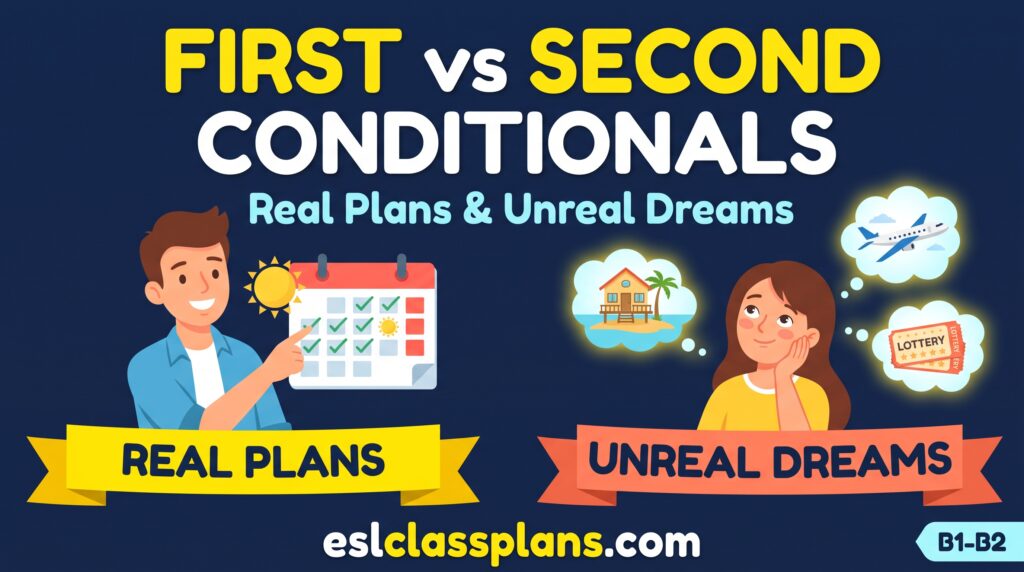
This ready-to-teach lesson plan bridges the gap using Task-Based Language Teaching (TBLT) and guided inductive discovery. By contrasting two relatable archetypes-the practical planner versus the dreamer-the lesson provides an intuitive mental anchor that clearly separates tangible real-world outcomes from hypothetical daydreams. Scaffolding moves seamlessly from reflective warm-up queries to targeted context checks, natural spoken contraction practice (‘ll and ‘d), and a situational workplace dialogue. Learners develop the confidence to state realistic plans, hypothesize without hesitation, and signal their exact degree of probability during casual conversations and collaborative workplace discussions.
What’s Inside This Lesson Plan?
- Dual-Perspective Warm-Up Reflection: Engaging starter questions contrast achievable weekend arrangements with impossible travel scenarios to immediately activate schema around probability versus imagination.
- Planner vs. Dreamer Core Concept Presentation: A clear comparative breakdown comparing David’s realistic financial goals with Leo’s lottery daydreams, establishing when to deploy if + present simple + will versus if + past simple + would.
- Guided Context & Contraction Checks: Targeted fill-in prompts (such as cancelling picnics or traveling the globe) that focus on contextual clues, form accuracy, and spoken contractions like we’ll and we’d.
- Three-Part Breakroom Chat Role-Play: An interactive communicative dialogue between colleagues Sarah and Tom, transitioning from urgent work deadlines and weekend party plans to whimsical escapes to Hawaii.
Core Target Language Spotlight
This lesson builds communicative precision by highlighting the functional contrast between realistic cause-and-effect projections and hypothetical daydreams.
- Real, Likely Present/Future Plans:
"If we finish our work early, we'll head out to dinner." - Hypothetical Situations & Unreal Daydreams:
"If we won the lottery, we'd buy a huge house by the beach."
Download the Ready-to-Print Classroom Handout
Equip your classroom with an adaptable, zero-prep lesson packet engineered for seamless instruction. Whether you are leading an in-person workshop or screen-sharing through digital platforms like Zoom or Google Meet, this complete resource includes clearly structured grammar presentations, guided practice exercises, full role-play scripts, and teacher answer keys.
📥 Download Printable Materials
Click below to access your printable PDF classroom materials.
Teacher’s Tip for the Classroom
Use the “Coin Toss vs. Magic Wand” visualization to help students quickly evaluate psychological distance before they speak. When students hesitate over which structure to choose, ask: “Are you flipping a coin (a realistic 50/50 possibility in the real world), or are you waving a magic wand (an imaginary scenario or daydream)?” If it is a coin toss, guide them toward the First Conditional (if + present, will); if it requires a magic wand, direct them to the Second Conditional (if + past, would). To reinforce natural pronunciation, drill the contracted forms we’ll /wɪəl/ and we’d /wiːd/ in choral repetition, reminding students that native speakers rarely enunciate the full auxiliary verbs will or would during casual conversation.


