
One of the most persistent hurdles for pre-intermediate and intermediate (A2–B1) English language learners is navigating the conceptual divide between the Present Perfect and the Past Simple. Students routinely struggle with L1 interference, treating English past tenses through the lens of their native grammar and producing errors such as “I have seen that movie yesterday” or abruptly using the past simple without establishing experiential context. Rote grammar drills often fail because students understand how to conjugate the verbs in isolation, but stumble when deciding whether an action is anchored to a finished historical point or remains an open, indefinite life experience connected to the present.
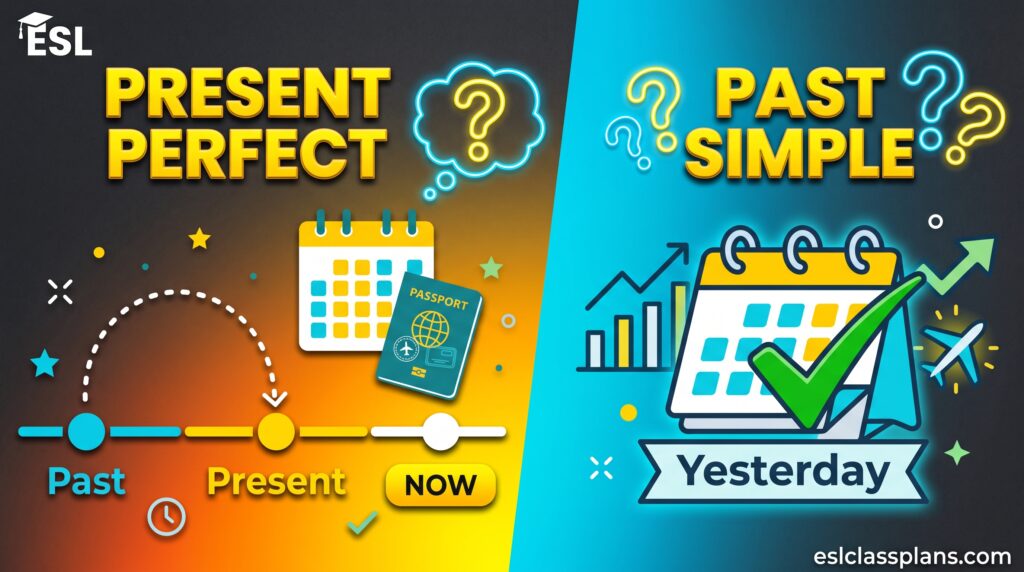
This ready-to-teach lesson plan addresses that friction directly through Communicative Language Teaching (CLT) principles and clear visual scaffolding. By introducing an intuitive timeline graphic to clarify temporal reference points, the lesson guides students from controlled signal-word identification to contextual reading and a multi-stage professional role-play. Learners systematically practice opening conversations with indefinite experiences before shifting into specific past details, empowering them to speak fluently during social introductions, networking events, and career discussions.
What’s Inside This Lesson Plan?
- Visual Timeline Presentation & Warm-Up: Engaging discussion questions about travel and achievements activate schema, while a clear timeline visual explicitly differentiates finished past points from indefinite experiences connecting to the present.
- Controlled Signal-Word Practice: A targeted sentence-completion activity challenges learners to select the correct tense using key temporal markers such as last summer, yet, ever, and two weeks ago.
- Travel-Themed Contextual Reading: A short narrative demonstrating authentic tense shifts, showing students how fluent speakers move smoothly between life milestones and specific trip details.
- Multi-Stage Networking Role-Play: A three-part communicative dialogue between colleagues at a global conference, equipping students to discuss career backgrounds, department travel, and project milestones in a professional setting.
Core Target Language Spotlight
The lesson builds functional accuracy by contrasting open-ended experiential inquiries with specific historical facts.
- Contrasting Indefinite Experience with Specific Past Dates:
"We have visited Japan."vs."We visited Japan in 2022." - Workplace Inquiries & Follow-Up Details:
"Have you traveled for work recently?"/"Yes, we flew to London in October for a conference."
Download the Ready-to-Print Classroom Handout
Equip your classroom with a complete, zero-prep slide deck and worksheet packet designed for immediate delivery. Whether you are leading face-to-face sessions or sharing your screen during online lessons via Zoom or Google Meet, this resource includes clear visual grammar guides, guided prompts, and high-engagement speaking tasks.
📥 Download Printable Materials
Click below to access your printable PDF classroom materials.
Teacher’s Tip for the Classroom
Teach your students the “Funnel Technique” to help them navigate conversational tense shifting. Explain that native speakers use the Present Perfect as a wide “conversation starter” to establish whether an event has ever occurred (e.g., “Have you ever been to the UK?”). Once the speaker confirms the experience, the conversation funnels directly into the Past Simple to investigate the concrete details of time, place, and manner (e.g., “Yes, we flew to London in October for a conference”). To prevent learners from combining the Present Perfect with finished time markers, draw a “Closed Past Box” on the whiteboard containing words like yesterday, last year, and two weeks ago—as a rule of thumb, remind students that as soon as a time marker enters that box, the auxiliary verb have/has must disappear.


