
At the intermediate (B1–B2) level, mastering the passive voice involves far more than formulaic sentence transformation. Many English language learners treat the passive purely as an artificial mechanical drill-flipping subject and object positions-without grasping its rhetorical function: shifting informational focus to the action or the entity receiving that action.
Consequently, students struggle with communicative intent; they either avoid passive constructions entirely because coordinating auxiliary verbs (am/is/are/was/were) with irregular past participles creates cognitive overload, or they produce unnatural utterances by appending unnecessary “by + agent” phrases to every sentence. Without a clear communicative context where the actor is unknown, obvious, or irrelevant, learners fail to appreciate why native speakers choose passive structures in journalism, technical explanations, and history.
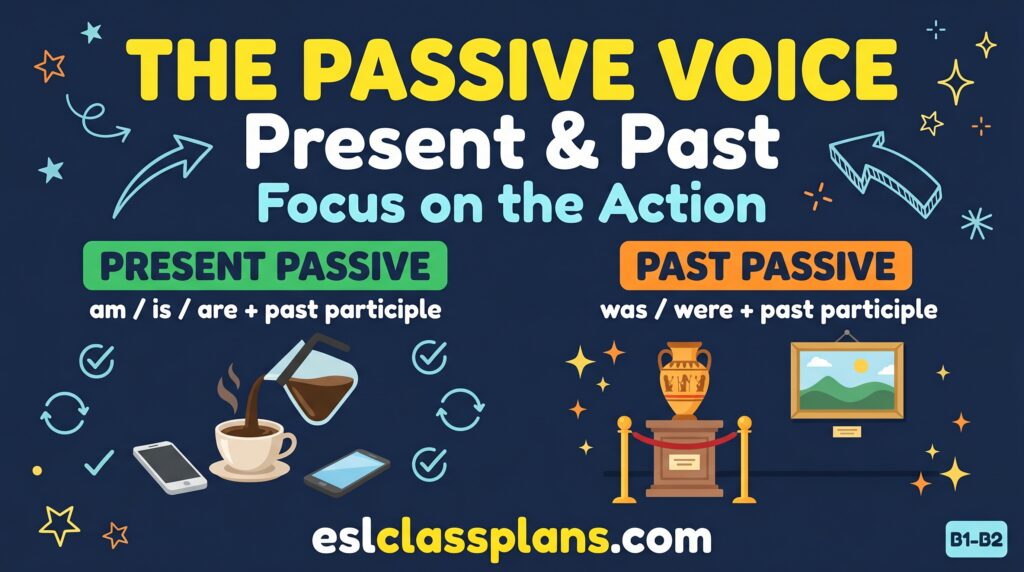
This ready-to-teach lesson plan demystifies the passive voice through Communicative Language Teaching (CLT) and contextualized inductive presentation. Rather than presenting abstract formulaic tables, the materials ground the present and past passive in communicative themes where the object naturally commands attention-such as global consumer products, cultural traditions, manufacturing processes, and historical artifact preservation.
The lesson scaffolds student production progressively, moving from personal schema-activating questions to targeted sentence completion, a process reading on the journey of cocoa, and an interactive museum tour role-play. By framing grammar around genuine communicative needs, students gain the confidence to describe historical milestones, explain step-by-step procedures, and handle professional inquiries with syntactic maturity.
What’s Inside This Lesson Plan?
- Everyday Origins Warm-Up Reflection: Engaging starter questions prompt learners to consider where their smartphones were made, what languages are spoken in their homes, and how coffee is traditionally prepared.
- Present & Past Passive Sentence Completion: A targeted practice activity reinforcing correct auxiliary agreement and participle forms across cultural and historical contexts, including the construction of the Eiffel Tower and Mediterranean olive oil production.
- “The Journey of Cocoa” Process Reading: A contextual reading passage detailing how cocoa beans are harvested, sun-dried, utilized by the ancient Maya, and refined into modern chocolate, illustrating shifts between historical events and present-day facts.
- Three-Part Museum Tour Role-Play: An immersive communicative simulation where students alternate as museum guides and curious tourists, exchanging details about an ancient Egyptian vase, a royal diamond, and a light-sensitive portrait.
Core Target Language Spotlight
This lesson develops functional accuracy by training students to highlight historical discoveries, preservation routines, and manufacturing processes while using the agent preposition “by” only when necessary.
- Contrasting Present Preservation with Historical Discovery:
"It was discovered in Egypt in 1922."/"It is kept in a temperature-controlled glass case, and it is cleaned by experts every month." - Describing Origins and Historical Context:
"Historically, the first chocolate drink was created by the ancient Maya thousands of years ago."
Download the Ready-to-Print Classroom Handout
Equip your classroom with an adaptable, zero-prep slide deck and worksheet packet engineered for immediate delivery. Whether you are leading an in-person seminar or screen-sharing through digital platforms like Zoom or Google Meet, this complete resource includes clearly structured grammar explanations, targeted gap-fills, process readings, and communicative role-play cue cards.
📥 Download Printable Materials
Click below to access your printable PDF classroom materials.
Teacher’s Tip for the Classroom
Use the “Spotlight Test” to cure students of the habit of appending an unnecessary “by + agent” to every passive clause. Explain that the passive voice functions like a stage spotlight: we only bring the doer onto the stage using “by” if their identity adds critical, surprising, or historically prominent information (e.g., “invented by Thomas Edison” or “written by J.K. Rowling”). If the agent is obvious, unknown, or unimportant (e.g., “The office is cleaned every day” rather than “by cleaners”), prompt students to keep the spotlight solely on the action and turn the agent off. Before launching into the museum role-play, run a quick 60-second choral drill contrasting singular and plural auxiliary verbs with past participles (“it was found” vs. “they were stolen”) to prevent agreement slips during free-flowing dialogue.