
For intermediate (B1–B2) English language learners, mastering modals of deduction presents a unique linguistic hurdle that extends far beyond auxiliary verb conjugation. Students routinely conflate epistemic modality (deducing the truth of a situation based on logical evidence) with deontic modality (expressing obligation, permission, or prohibition). This confusion triggers persistent, fossilized errors-most notably the tendency to say “It mustn’t be true” rather than “It can’t be true” when expressing negative logical certainty.
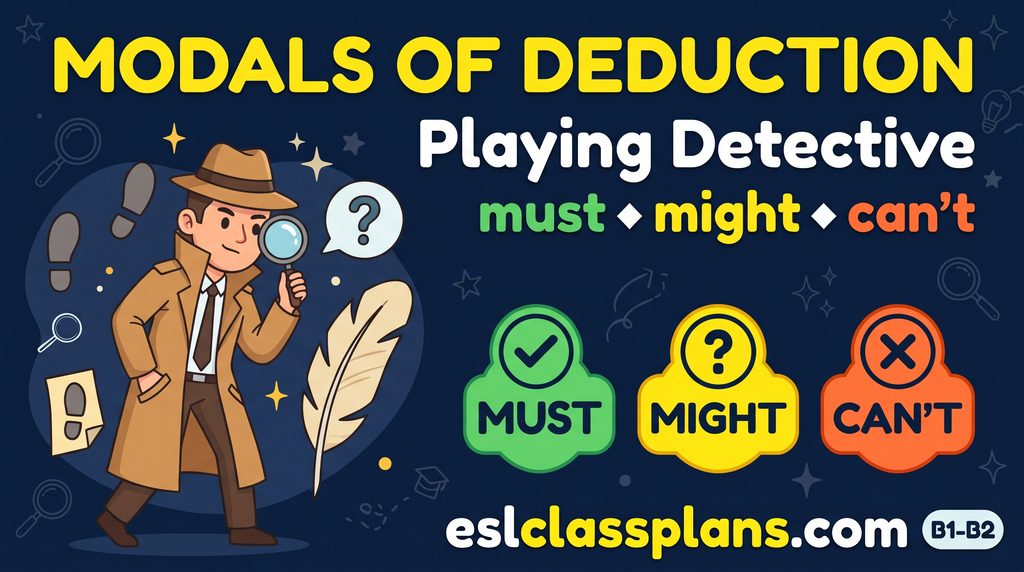
Furthermore, learners frequently struggle to nuance varying degrees of probability, defaulting almost exclusively to clumsy lexical qualifiers like “maybe” or “perhaps” rather than integrating modal auxiliaries smoothly into spoken conversation. Standard fill-in-the-blank drills often fail to resolve this friction because logical deduction cannot occur in an informational vacuum; it requires an unfolding narrative where students actively assess evidence, challenge assumptions, and re-evaluate hypotheses.
This ready-to-teach lesson plan addresses these challenges by merging Communicative Language Teaching (CLT) with Task-Based Language Teaching (TBLT) through an interactive, gamified detective investigation. Scaffolding learners from structured discovery to authentic speaking production, the lesson introduces an intuitive probability continuum (100% certainty, 50% possibility, 100% negative impossibility) and pairs it with targeted sentence-completion checks.
Students then take on the roles of Lead Detective and Assistant to solve “The Mystery of the Missing Mascot,” systematically analyzing clues, eliminating suspects, and re-calibrating their conclusions as fresh evidence comes to light. By anchoring modal structures in a collaborative problem-solving task, learners gain the syntactic accuracy, communicative precision, and confidence needed to evaluate evidence and express certainty across social, academic, and professional settings.
What’s Inside This Lesson Plan?
- Campus Life Warm-Up & Deductive Schema Activation: Thought-provoking discussion prompts tapping into university experiences and hypothetical scenarios-such as cheering in a library-to elicit spontaneous deductive reasoning.
- Evidence-Based Rules & Controlled Gap-Fill Practice: A clear conceptual breakdown linking degrees of certainty to must, might, and can’t, followed by targeted gap-fill deductions based on physical clues like darkened rooms and student attire.
- “The Mystery of the Missing Mascot” Case File: An engaging reading passage detailing the overnight disappearance of a university’s lucky eagle mascot costume right before a championship game, introducing three plausible suspects.
- Three-Part Detective Investigation Role-Play: A collaborative speaking activity where student pairs act as Lead Detective and Assistant, evaluating clues, alibis, and camera footage regarding a rival captain, a sleeping student, and a campus janitor.
Core Target Language Spotlight
This lesson refines communicative precision by training students to match their level of certainty and available evidence with the correct modal verb.
- Expressing Logical Impossibility and Negative Certainty:
"That can't be the professor; he looks too young and is wearing a student uniform!" - Balancing Hypotheses with Contradictory Evidence:
"The rival captain might have taken it as a prank... Then the captain can't be the one who took it!"
Download the Ready-to-Print Classroom Handout
Equip your classroom with an adaptable, zero-prep slide deck and worksheet packet engineered for immediate delivery. Whether you are leading an in-person seminar or screen-sharing through digital platforms like Zoom or Google Meet, this complete resource includes clearly structured grammar explanations, targeted gap-fills, narrative case files, and interactive role-play scripts.
📥 Download Printable Materials
Click below to access your printable PDF classroom materials.
Teacher’s Tip for the Classroom
Address the persistent “Mustn’t vs. Can’t” deduction error early using the “Rules vs. Reality” framework. Remind students that mustn’t is strictly reserved for prohibition and rules (e.g., “You mustn’t park here”), whereas can’t is the mandatory opposite of must when deducing reality from evidence (e.g., “The lights are off; they can’t be home”). During the detective role-play, reveal suspect alibis incrementally rather than all at once. Forcing students to hear contradictory evidence mid-conversation prompts them to audibly revise their deductions in real time (e.g., shifting dynamically from “He might have taken it” to “He can’t have taken it”), mirroring how fluent speakers adjust epistemic stance as new facts emerge.