
At the intermediate (B1–B2) level, mastering complex sentence structures is a vital milestone for moving beyond simple coordination toward fluent, mature English. However, relative clauses present persistent challenges for learners, particularly when navigating the distinction between defining (restrictive) and non-defining (non-restrictive) clauses. Students frequently struggle with the dual hurdle of punctuation and pronoun constraints: they insert commas randomly, incorrectly use “that” in non-defining clauses, or fail to use the commas that signal natural spoken pauses.
Furthermore, without a clear understanding of communicative necessity, learners often produce fragmented, repetitive sentences (“Chef Antonio is coming. He runs a restaurant. It is famous.”) instead of smoothly integrating essential identifiers or parenthetical details. Isolated sentence-combining drills often fail because learners need a rich communicative context to decide whether a piece of information is critical for identifying the subject or simply an interesting aside.
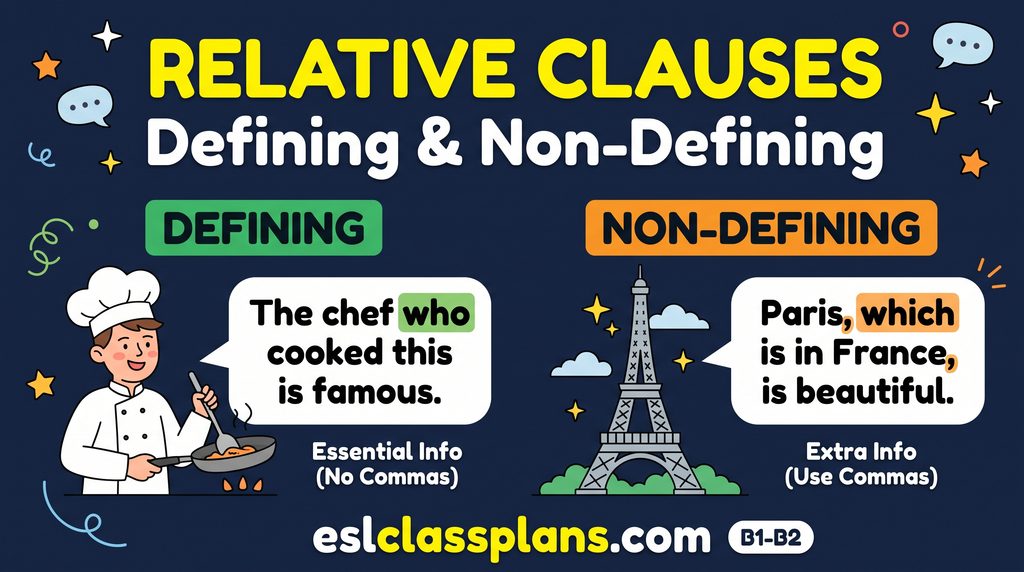
This ready-to-teach lesson plan resolves this issue by combining Communicative Language Teaching (CLT) with Task-Based Language Teaching (TBLT) through an engaging event-management theme. Set against the backdrop of planning a major “Global Food Festival,” the lesson provides an authentic, high-stakes operational context where distinguishing between vital specifications and extra background details directly impacts event logistics.
The material scaffolds student understanding progressively-advancing from personal warm-up reflections to controlled pronoun selection and comma-placement checks, followed by an authentic event-planning scenario and a multi-part role-play between an Event Manager and an Assistant Coordinator. Through this purposeful structure, students gain practical fluency in connecting ideas, mastering spoken intonation pauses, and choosing the correct relative pronouns (who, which, that, where, whose) with confidence.
What’s Inside This Lesson Plan?
- Personal Reflection Warm-Up: Engaging starter prompts encourage students to describe humorous friends, reflect on ideal cities to live in, and compare short and simple stories with detailed narratives to activate descriptive language.
- Targeted Pronoun & Comma Placement Practice: A focused sentence-completion activity challenging learners to select appropriate relative pronouns (who, which, where, whose) and apply proper comma punctuation across varied everyday and workplace contexts.
- “The Global Food Festival” Event Brief: A contextual scenario introducing an event management agency’s final preparations for culinary vendors, entertainment stages, and media guests, illustrating how relative clauses organize complex logistics.
- Three-Part Event Planning Role-Play: A collaborative speaking simulation where students act as Senior Event Manager and Assistant Coordinator, resolving last-minute challenges involving award-winning guest chefs, flooded music stages, and international VIP critics.
Core Target Language Spotlight
This lesson refines communicative precision by contrasting essential identifying information with parenthetical background details.
- Adding Extra Descriptive Details (Non-Defining with Commas):
"Chef Antonio, who runs the famous pasta restaurant downtown, will be there at noon." - Specifying Essential Logistical Details (Defining without Commas):
"Let us move it to the indoor hall that we reserved as a backup."
Download the Ready-to-Print Classroom Handout
Equip your classroom with an adaptable, zero-prep slide deck and worksheet packet engineered for immediate delivery. Whether you are leading an in-person seminar or screen-sharing through digital platforms like Zoom or Google Meet, this complete resource includes clearly structured grammar explanations, targeted gap-fills, narrative case files, and interactive role-play scripts.
📥 Download Printable Materials
Click below to access your printable PDF classroom materials.
Teacher’s Tip for the Classroom
Teach your students the “Finger Cover Test” to eliminate confusion over whether a clause is defining or non-defining. Have students place a finger over the relative clause and read the remaining sentence aloud: if the subject’s identity becomes unclear or confusing (e.g., “The tour guide… will greet them”, prompting the question “Which tour guide?”), the clause is essential (defining), meaning no commas are used and that is permitted.
If the main subject is already unique and clearly identified and the remaining sentence still communicates a complete, sensible thought (e.g., “Chef Antonio… will be there at noon”), the clause provides bonus information (non-defining)-meaning commas are mandatory and that cannot be used. In speech, remind students that commas represent audible micro-pauses with a slight drop in pitch, helping them sound more natural and rhythmic when delivering non-defining information.