At the intermediate (B1–B2) level, mastering future forms is one of the most common communicative stumbling blocks. While learners can easily memorize the structural mechanics of will, going to, and the present continuous, they routinely treat them as interchangeable synonyms. In many native languages, a single future marker or present tense covers all upcoming events.
Consequently, English learners default almost exclusively to will for every situation-producing unnatural statements such as “Tomorrow at 2 PM I will meet my doctor” or “Look at those black clouds, it will rain.” Isolated fill-in-the-blank drills fail to resolve this issue because grammatical choice in English does not depend on chronological time alone; it depends entirely on the speaker’s communicative intent, prior preparation, and the presence of immediate external evidence.
This ready-to-teach lesson plan resolves this friction through Communicative Language Teaching (CLT) and Task-Based Language Teaching (TBLT). Grounded in the collaborative, fast-paced scenario of organizing a “Community Summer Festival,” the lesson provides a genuine operational reason to choose one future form over another.
Scaffolding moves systematically from personal scheduling reflections to clear grammatical rule distinctions, targeted gap-fill checks, and an interactive crisis-management role-play. Students learn to navigate real-time disruptions-such as canceled caterers, sudden rainstorms, and delayed musicians-equipping them to express fixed arrangements, prior intentions, evidence-based predictions, and spontaneous on-the-spot decisions with natural spoken fluency.
What’s Inside This Lesson Plan?
- Community Planning Reflection & Warm-Up: Engaging starter questions exploring how students structure their weekends, whether they prefer rigid schedules or spontaneous choices, and their past experiences organizing community gatherings.
- Functional Grammar Matrix & Targeted Practice: A clear comparative framework separating fixed appointments, premeditated plans, and instant decisions, reinforced through festival-themed sentence completion exercises.
- “The Community Summer Festival” Event Brief: An authentic scenario introducing the logistics of an upcoming town festival suddenly thrown into disarray by vendor cancellations and shifting weather forecasts.
- Three-Part Crisis Management Role-Play: A multi-stage collaborative dialogue where students partner up as the Event Manager and Assistant Coordinator to resolve sudden emergencies using appropriate future forms.
Try the Activity Online: Interactive Planning Simulation
Give your students an instant, interactive way to practice these grammar rules before or during class. Work through the three live scenarios below and select the correct future form based on context:
Scenario 1: The Sudden Cancellation
- Situation: You are in the festival office. The phone rings, and your main food supplier pulls out at the last minute.
- Prompt:“The caterer just canceled! Don’t worry, I ________ (call) the local food trucks right now.”
- A) am calling (Present Continuous – Fixed arrangement)
- B) will call (Will – Spontaneous decision made at the moment of speaking)
- C) am going to call (Going to – Plan decided beforehand)
- Correct Answer: B (will call) -This is an instant decision and offer made in direct response to immediate news.
Scenario 2: The Scheduled Meeting
- Situation: You are reviewing your printed schedule for tomorrow morning. The meeting was confirmed last week.
- Prompt:“We ________ (meet) the town council tomorrow at 9:00 AM in Room 4.”
- A) are meeting (Present Continuous – Fixed arrangement with time and place)
- B) will meet (Will – Instant decision)
- C) meet (Present Simple – Timetable/routine only)
- Correct Answer: A (are meeting) – The time, place, and participants are mutually arranged and fixed on the calendar.
Scenario 3: The Gathering Storm
- Situation: You step outside and notice dark, heavy storm clouds gathering directly above the outdoor stage.
- Prompt:“Look at the sky! It ________ (rain) before the opening ceremony starts.”
- A) will rain (Will – Speculative opinion)
- B) is going to rain (Going to – Prediction based on present, visible evidence)
- C) is raining (Present Continuous – Action currently in progress)
- Correct Answer: B (is going to rain) – Direct sensory evidence in the present makes this outcome imminent.
Core Target Language Spotlight
This lesson refines communicative precision by aligning future forms with specific levels of planning, certainty, and immediate context.
- Confirming Fixed Calendar Appointments:
"We are meeting the food vendors tomorrow at 9 AM in the town hall." - Making Spontaneous Crisis Decisions:
"Do not worry, we will call the local food trucks right now and ask them to come instead!" - Expressing Evidence-Based Predictions:
"Look at those dark clouds! It is going to rain during the festival."
Download the Ready-to-Print Classroom Handout
Equip your classroom with an adaptable, zero-prep slide deck and worksheet packet engineered for immediate delivery. Whether you are leading an in-person seminar or screen-sharing through digital platforms like Zoom or Google Meet, this complete resource includes clearly structured grammar explanations, targeted gap-fills, narrative case files, and interactive role-play scripts.
📥 Download Printable Materials
Click below to access your printable PDF classroom materials.
Teacher’s Tip for the Classroom
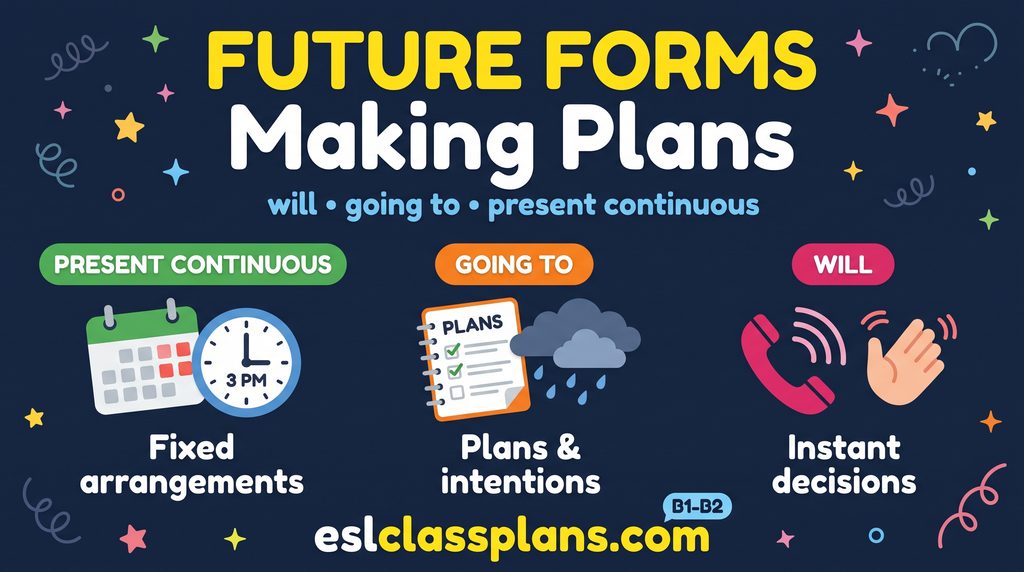
Teach students the “Calendar, Brain, or Reflex” test to immediately clear up confusion between future forms:
- The Calendar (Present Continuous): Ask, “Is this written in your calendar with another person, place, or exact time?” If yes, use the Present Continuous (“We’re meeting at 3 PM”).
- The Brain (Going to): Ask, “Did you decide this inside your head before this exact moment?” If yes, use going to (“We’re going to hire a band”).
- The Reflex (Will): Ask, “Did you just make this decision right this second as a reaction?” If yes, use will (“The phone is ringing-I’ll get it!”).
During the festival role-play, encourage students to listen closely to their partner’s cues: when an unexpected problem is introduced, remind them that their first response must always be a spontaneous “Reflex” (will), not a pre-planned intention.